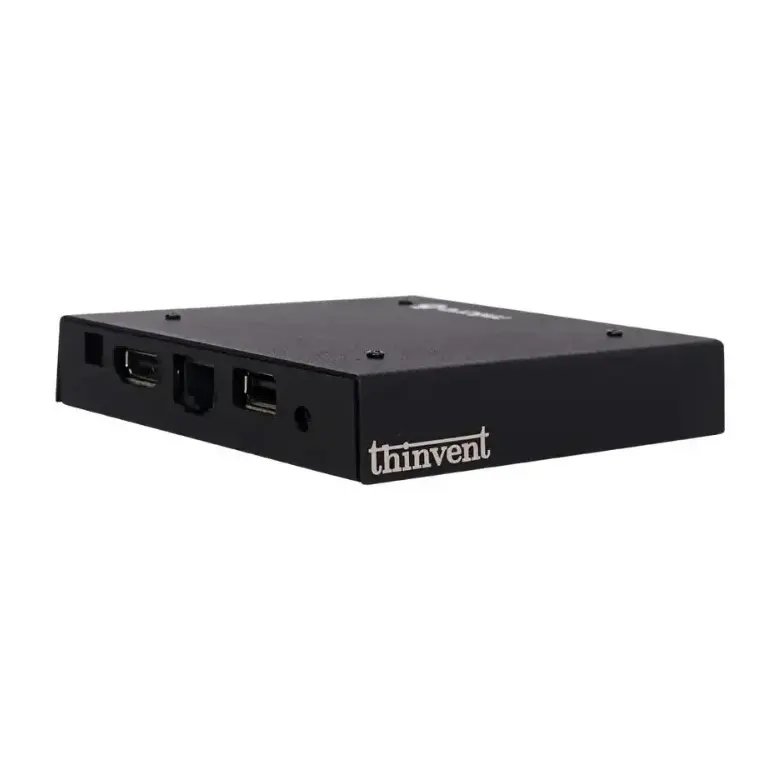
What Is a Zero Client PC?
A zero client PC is an ultra-thin endpoint device designed specifically for secure remote access to virtual desktops or centralized server environments. Unlike traditional thin clients that retain some local processing capability, zero clients have no operating system, no local storage, and no moving parts—they function purely as a display and input interface. All computing, data processing, and storage occur on a remote server or virtual desktop infrastructure (VDI), making zero clients inherently secure because no data ever resides locally.
Key Specifications and Technical Details
Zero client PCs typically feature low-power processors such as ARM Cortex or Intel Atom/N-series chips, minimal RAM (often 2–8 GB), and flash storage (eMMC or small SSDs) only for booting a lightweight embedded OS. They rely on network protocols like PCoIP, HDX, RDP, or SPICE to stream the desktop experience from a host server. Essential specifications include:
-
Processor: ARM Cortex A53/A55 (4 cores, up to 2.0 GHz) or Intel N100 (4 cores, up to 3.4 GHz)
-
Memory: 2–8 GB RAM (sufficient for protocol handling and caching)
-
Storage: 16–128 GB eMMC or SSD (primarily for firmware/OS)
-
Connectivity: Gigabit Ethernet, dual-band WiFi, HDMI output, USB ports
-
Power Consumption: Ultra-low (5–12V, 2–5A typical)
These devices are fanless, silent, and compact—often smaller than a paperback book—making them ideal for clutter-free workspaces.
Use Cases and Applications
Zero client PCs excel in environments where security, centralized management, and low total cost of ownership (TCO) are critical:
-
Healthcare: HIPAA-compliant access to electronic health records (EHR) without storing patient data locally.
-
Finance: Secure trading floors and banking terminals where data must never leave the data center.
-
Government & Defense: Classified networks requiring strict data isolation and endpoint lockdown.
-
Education: Virtual computer labs where students access powerful applications from low-cost endpoints.
-
Call Centers: High-density deployments with centralized desktop management and rapid user switching.
The key benefit is simplified IT management—administrators update and patch a single server image instead of hundreds of endpoints, and zero clients are nearly immune to malware since they run no local applications.
Comparison: Zero Client vs. Thin Client vs. Mini PC
| Feature | Zero Client | Thin Client | Mini PC |
|---|---|---|---|
| Local OS | None (or minimal firmware) | Lightweight OS (Linux, Windows IoT) | Full OS (Windows, Linux) |
| Local Storage | None or minimal (firmware only) | 16–128 GB eMMC/SSD | 128 GB+ SSD |
| Processing | Server-side only | Some local apps possible | Full local processing |
| Security | Highest (no data at rest) | High (data can be cached) | Moderate (local data risk) |
| Power | 5–10W typical | 10–30W typical | 15–65W typical |
| Management | Zero-touch, PXE/cloud | Centralized but more complex | Per-device or group policy |
| Cost | Lowest per-seat | Low per-seat | Moderate per-seat |
Thinvent's Zero Client and Thin Client Portfolio
Thinvent offers a comprehensive range of ultra-thin endpoint devices suitable for zero client and thin client deployments. Our ARM-based Micro series (Micro 5 and Micro 6 Pro) feature Cortex A53/A55 processors, 2–4 GB RAM, and 16–64 GB eMMC storage, running our proprietary Thinux Embedded Linux for instant-on, secure access. For customers needing slightly more local capability, our Intel N100-based Treo Mini PC and IPC1 Industrial PC provide 4 GB RAM and 128 GB SSD with Ubuntu or Thinux. All models support gigabit Ethernet, HDMI output, and optional WiFi, with fanless designs for silent operation and long-term reliability in 24/7 environments.